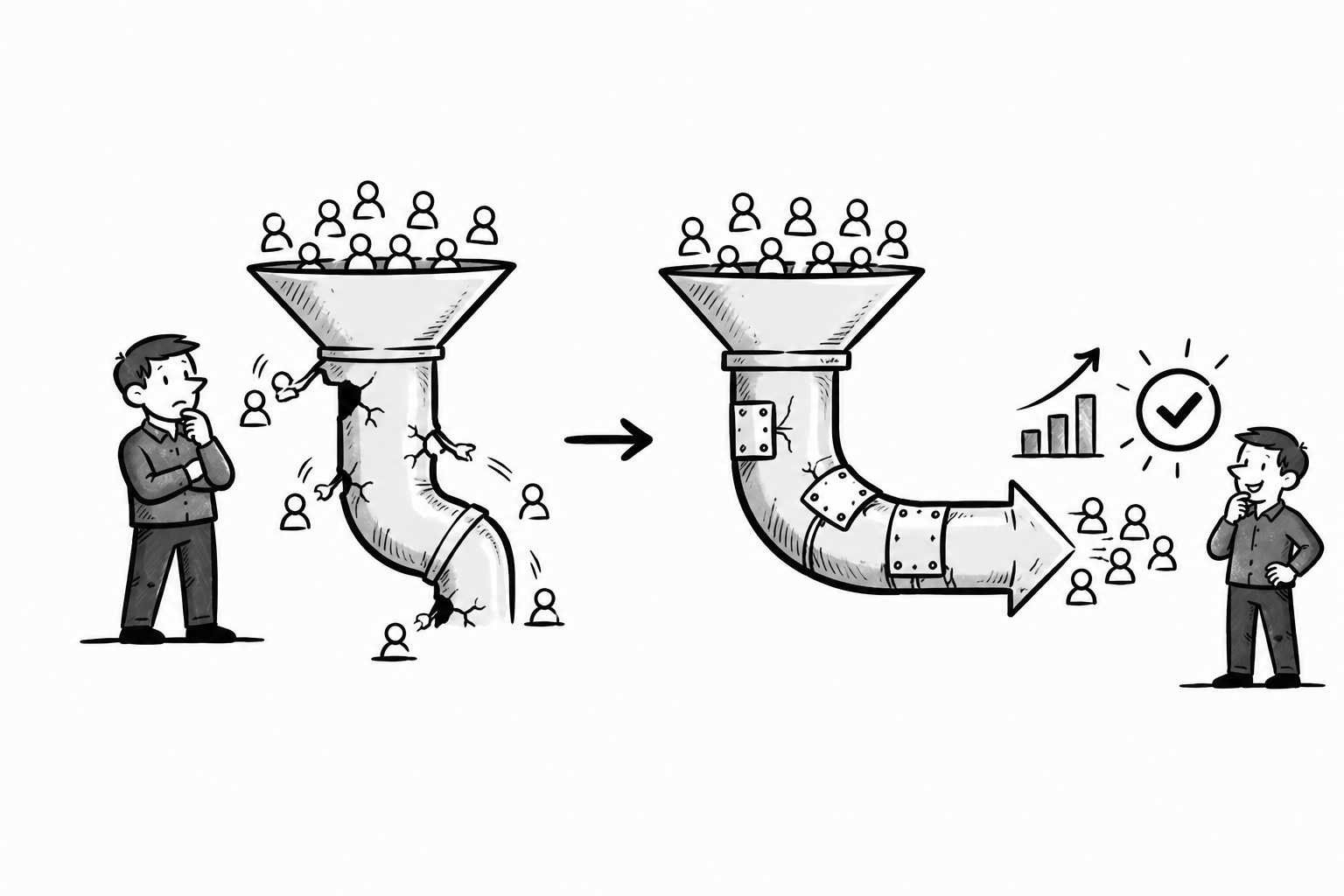
Stop looking for churn in the wrong place
One day you wake up, take a look at the analytics dashboard and see that something is clearly wrong. Your signups are fine, trial conversions are okay-ish, but your users keep disappearing. You try to fix this, so you add an onboarding email, simplify the setup flow, and the numbers move a little, then flatten. So you try something else, but it's still not obvious what's broken, and it's not even obvious where you should look. The reason it's hard to find is that the problem usually isn't in the place you're looking. It's in a specific moment, or a few of them, where the product failed to give the customer a reason to keep going. That's the moment you need to find.
Activation is not a checklist
The first instinct is to look at metrics, and that's where a lot of teams get stuck. They define activation mechanically, with events like finished onboarding, created project or connected integrations. They pick the action that's easy to track, call it activation and watch the graphs. This is the lazy way of doing things.
The problem here is that completing a step is not the same as getting value. Activation is the first moment when a customer gets proof that your product can do the job they came for, and it's as functional as emotional.
To find this moment, ask yourself what a customer would need to see, with their own data, in their own context, to call their colleague and say "okay, we're using this." That moment, whatever it is for your product, is your real activation event. If your tracked event isn't that moment, you're measuring the wrong thing.
Be careful: strong onboarding completion can sit right next to weak activation, and if you're only watching completion rates you'll miss the real problem.
Retention risk forms before retention metrics move
Churn is late information, because you know... by the time it appears in a dashboard, the story is already over.
The risk shows up much earlier, and a customer journey can fail long before the metrics make it obvious.
The risk shows up much earlier, look at this basic customer journey:
None of those events says "churn" on its own, and together they describe a journey that's failing to build momentum.
This gets missed because teams split the story in half. Activation gets treated like an onboarding problem and retention gets treated like lifecycle messaging. The actual break often sits right in the middle, where the customer is quietly deciding whether this belongs in how they already work.
Retention starts the first time a customer asks, consciously or not, "Is this worth adding into how we already work?" In B2B SaaS it's often around day three, in B2C it's much sooner.
A practical thing to do here: go back through your last five churned accounts and try to write down the first moment something went wrong, not when they cancelled. Instead look for the earliest signal you can find. In almost every case it's somewhere in week one or two, that's the window for you to obsess over.
The data is usually already there
When founders realize they don't understand why users churn, the instinct is often to add more analytics, get more data and somehow conclude from there.
Very often the data already exists, it's just split across too many places. The product analytics tell you where usage dropped, support tickets show what users found confusing and sales calls tell you what they expected before they arrived... The story is there, you just need to put it together from the broken pieces.
Early on, the founder is usually "the system" that holds all of this together. You remember the complaint, the churned account and everything in between. That works fine until the product gets complex enough that memory stops being a reliable operating model.
That's when something dangerous happens: product decisions get made from remembered fragments while feeling like they're being made from real understanding.
The practical fix can be very low-tech. Keep a running document, nothing fancy, where you record the pattern every time you talk to a churned customer or read a support thread that mentions confusion. After ten entries, you'll start to see the same two or three moments appearing again and again—those are your real activation problem.
The question most teams don't ask
When activation is low, the typical question is "why is activation down?"
That's too broad, it leads you to generic answers, such as improving onboarding, adding more emails or redesigning the dashboard. These things may help, but may not, as your problem is still not discovered.
A better question you should ask yourself: what had to happen for this specific customer to trust the product enough to keep going, and where did that sequence break?
That question forces you to look at a person moving through your product, not just at a pile of event counts.
See the difference between these two problem statements:
The second version gives you friction to work on, while the first version leads to a meeting.
To write the second version for your product: pick one user persona, pick one moment in your funnel where you see drop-off, and then write a paragraph in plain English describing what that specific person was thinking and feeling at that exact moment. Not what the data says, but what was going on in their head. If you can't write that with confidence, that's the gap in your customer journey.
Find the journey moments that create churn before churn shows up
Activation and retention are one story
Treating them as separate is one of the most common structural mistakes I see startups make. Let's set an example:
The onboarding team improves early conversion rates. Three months later, someone else notices weak retention and starts building lifecycle interventions on top of a product experience that was never strong enough in the first place. The interventions are trying to fix something upstream that they don't own and can't see.
The deeper issue is not whether someone got activated. It's what kind of activation happened.
A disposable success or a durable one? A completed task or the beginning of a habit? One person getting value, or the whole account becoming stronger?
If the first value moment is shallow, your retention will be too. If activation depends on one motivated internal champion, then the expansion will be fragile. The account might look active for months while still being at risk, and usually is, right up until it isn't.
Find the moments that predict the future
When I look at a customer journey, I'm trying to find the small set of moments that separate customers who are merely present from customers who are actually on their way.
Not every step is equally predictive; some are administrative, necessary but not meaningful. The important ones tend to involve real stakes: importing live data instead of test data, completing the same workflow two weeks in a row, getting a second user into the product before day fourteen.
There are a few moments in the first few weeks that predict whether an account will matter in thirty days. Finding those moments is essential for you, as it is where the useful retention work starts.
Here's a concrete way to find yours: take your 10 longest-retained customers and your 10 quickest churns, then compare what they did differently in their first two weeks.
You're not looking for everything, just the one or two actions that almost all the retained customers did and almost none of the churns did. That's your leading moment—build your onboarding around getting every new user there as fast as possible.
Once you find it, the work becomes much less abstract.
How to actually think about your customer's journey
A customer journey is just a way of writing down what a customer has to do, think, and feel to get from "signed up" to "this is now part of how we work." Most SaaS products have maybe eight to fifteen meaningful moments in that sequence.
It matters to write this down because product teams usually make decisions as if users experience a product as a set of features. They don't. Users experience it as a sequence. A feature can work perfectly in isolation and still kill momentum because it appears too early or asks for too much effort.
The mistake most founders make is that they create something that never gets updated, so it quickly becomes irrelevant. When product updates, the journey needs to update too.
A static map that was accurate three months ago is worse than no map at all, as it creates false confidence. What you need is less of an artifact and more of a living system, something that absorbs new evidence and keeps the picture current. That's the problem I'm building Custory to solve.
Remember the essentials
By the time churn shows up clearly, the real story usually happened weeks or months earlier.
The weak points often look small while they’re forming: a setup step that asks for trust too early, an empty state that creates no momentum, or a first value moment that isn’t strong enough to become a habit.
You should map your customer journeys. They help you see where belief is created, where momentum breaks, and which early moments predict whether a customer will stay.
Once you can see that sequence clearly, activation and retention stop feeling like mysterious numbers. They become product problems you can actually work on.
That's also what we're building Custory for: keeping customer journeys connected to real evidence and close to the product work. Come create your first customer journey.
Filip Šanda
Co-founder & CEO